
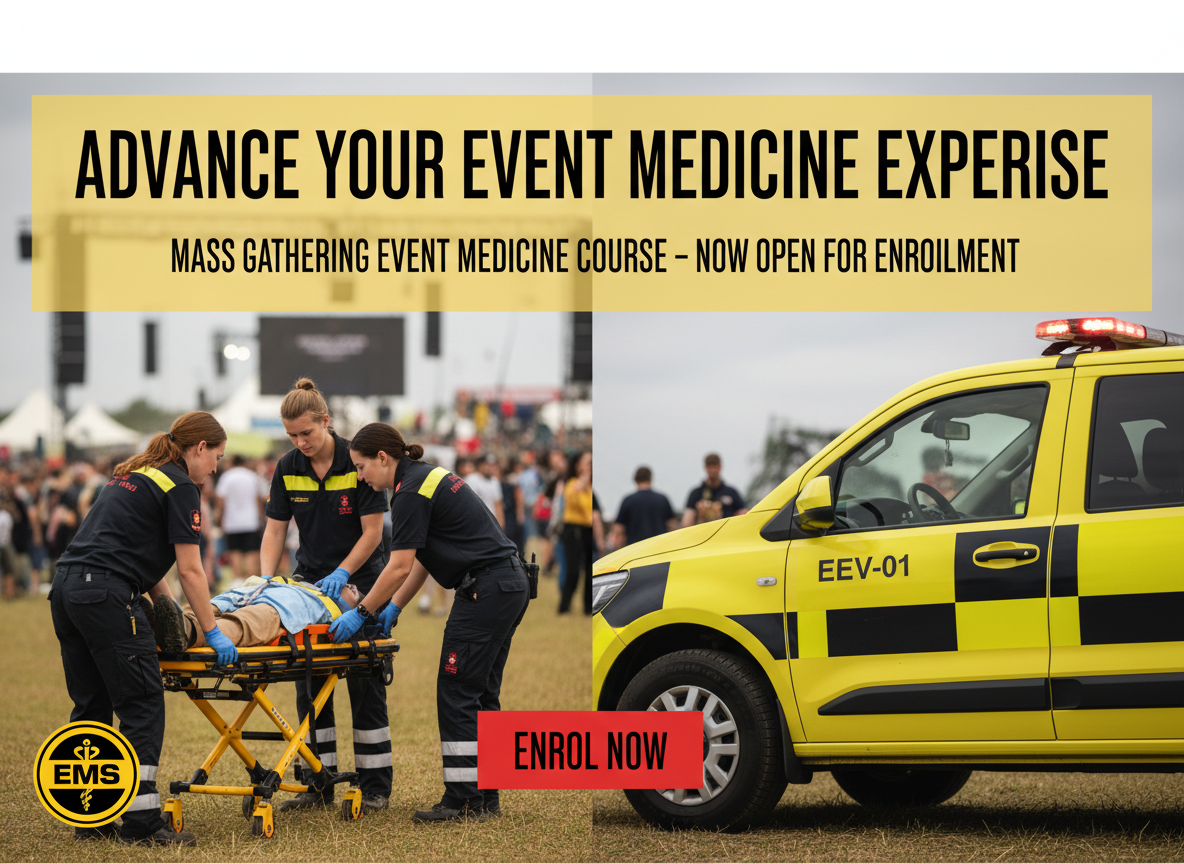
Written by Dr Mike Hammond (PhD, PHCEM, PA-RM), with 34 years of experience in mass gathering event medicine, this comprehensive course includes
Delivering practical, evidence-based guidance for paramedics, emergency doctors, nurses, event medics, and EMTs working at festivals, concerts, and mass gatherings.
Emphasis is on the Australian Events Industry; however, it can be adapted to any world region.
What’s Inside:
1.1 The Australian Context (NSW default)
1.2 NSW Festival Guidelines Integration
1.3 NSW Festival Compliance Checklist
1.4 Risk Modelling & Arson Protocol
1.5 Staffing Models
2.1 National Regulation (AHPRA)
2.2 Legislation: Drugs, Poisons & Health Acts
2.3 Ambulance Liaison & Escalation
3.1 Duty of Care
3.2 Consent, Capacity & Restraint
4.1 Medication Governance & Safety
4.2 Scope of Practice Tables
4.3 OTC medicines & paediatric readiness OTC governance controls
Common OTC categories Paediatric medication readiness
5.0 Festival triage: where to manage?
5.1 Toxidrome recognition
5.2 FoS “first 3 minutes” overdose card
5.3 a Festival red flags (NSW Ambulance triggers)
5.4 b Unknown collapse in the pit
5.5 Alcohol intoxication and poisoning
5.6 Observation Bay protocol
5.7 Opioid overdose
5.8 Psychostimulants and MDMA
5.9 GHB/GBL and benzodiazepines
5.10 Mixed/unknown overdose: minimum safe approach
5.11 Decision aid: Return/Discharge/Ambulance
5.12 Harm minimisation interfaces
6.1 Heat illness & rapid cooling Heat exhaustion vs heat stroke
NSW-default suspected heat stroke pathway
6.2 Crowd Crush
6.3 Minor Wound Care & Blisters
7.1 Command & Control
7.2 Triage Sieves & Sort
8.1 Mandatory Reporting & Safeguarding
8.2 Documentation Standards
9.1 Festival communications principles
9.2 Radio etiquette & call-signs
9.3 Standard message format
9.4 IMIST-AMBO Handover
9.5 Downtime procedures
10.1 Event public health risks
10.2 Isolation and cohorting
10.3 b Modifiers (camping / 18+ licensed)
10.4 PPE and sharps discipline
11.1 Paediatrics
11.2 Pregnancy and post-partum
11.3 Disability, neurodiversity, access
11.4 Older adults and comorbidity load
12.1 AED coverage model
12.2 Cardiac arrest rehearsal checklist
13.1 Minimum dataset (MDS)
13.2 Practical KPIs (festival)
13.3 After-action review (AAR)
14.1 Festival PMA location and footprint
14.2 Patient flow model for festivals
14.3 Extraction routes & front-of-stage
14.4 Festival staffing roles
14.5 Surge planning for headline sets
14.5a Modifiers (camping / 18+ licensed)
15.1 Medical causes of agitation
15.2 De-escalation workflow
15.3 Disposition thresholds Appendix A: Equipment Checklists Appendix B: Clinical Templates & Cards
Operational Cards (print, cut, laminate) Card 1: FoS “first 3 minutes” overdose card Card 2: Observation bay protocol
Card 3: Disposition decision aid
Card 4: Paediatric OTC & readiness mini-card
Key Features:
✅ Integration of NSW Festival Guidelines compliance checklist
✅ Data-driven approach with numeric targets, surge triggers, and safety thresholds
✅ Comprehensive equipment checklists for BLS, ALS, PMA, paediatric, and cooling kits
✅ Safeguarding, documentation, and mandatory reporting frameworks
✅ Print-ready format: A4 textbook + A5 laminated cards for field use
Perfect for: Those requiring Clinical training for mass casualty and event medicine, event planning, operational reference, and professional development in the rapidly growing field of mass gathering event medicine.